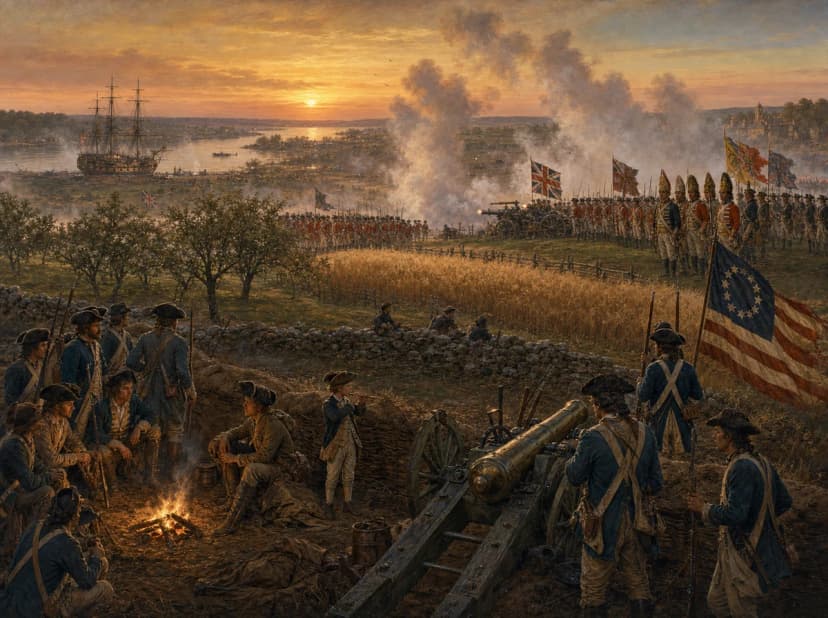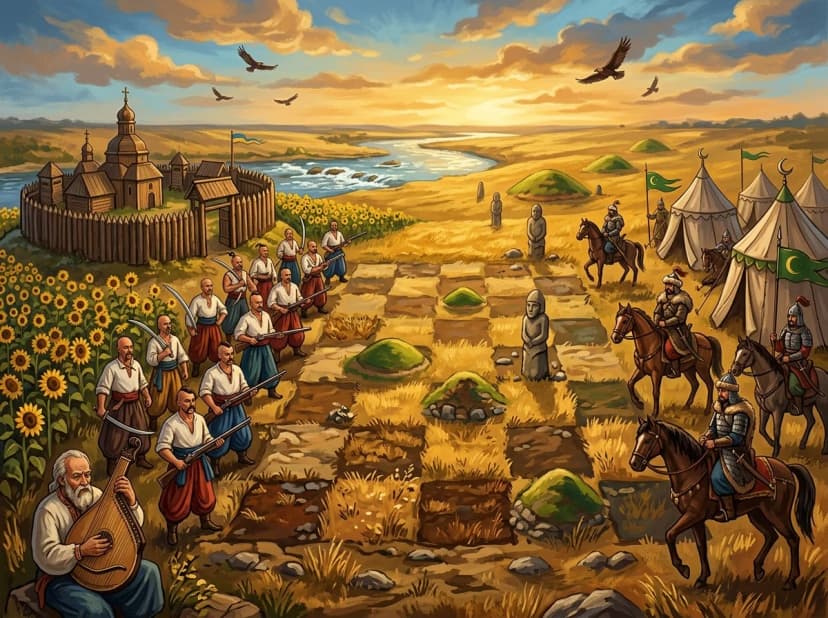
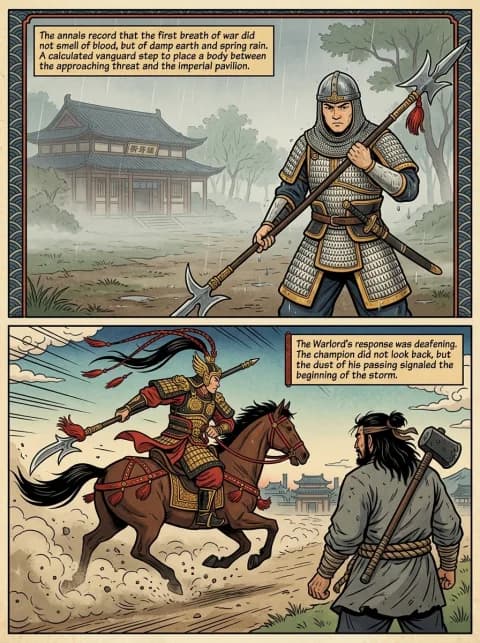
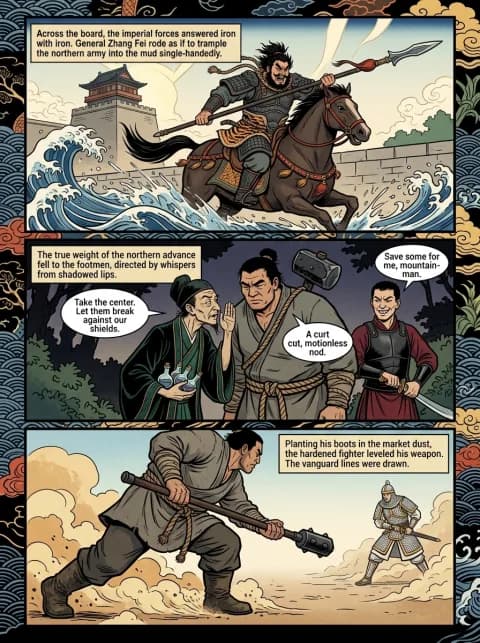
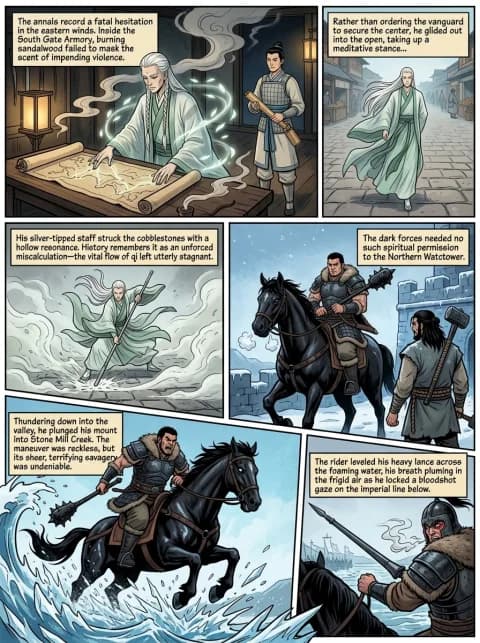
The style this page describes is a rebuild, and it is worth saying why. The first Monumental was a carved marble relief: one stone, three depths, a raking light. It worked, but it answered the wrong brief. Monumental painting is a category with a long history of its own — painting bound to a wall, made for a building, read across a room — and it is painted, not cut. So the style was rebuilt from the tradition that category actually names, and every rule in it now lives in rendering: medium, surface, pigment, plane, light, stage. None of it can be dressed away by a world's own costume.
What the Monumental style was built on
Thirty-three plates were gathered and adjudicated: fifteen kept as full evidence, six kept as detail annexes to a plate already counted, five kept for one scoped claim each, seven rejected. Every citable plate is a public-domain reproduction of a wall painted by an artist dead before 1500 — Giotto's Scrovegni Chapel in Padua, Masaccio's Brancacci Chapel and Fra Angelico's San Marco in Florence, Piero della Francesca's Arezzo cycle — plus one 1873 fresco by Hans von Marées kept to prove a single thing.
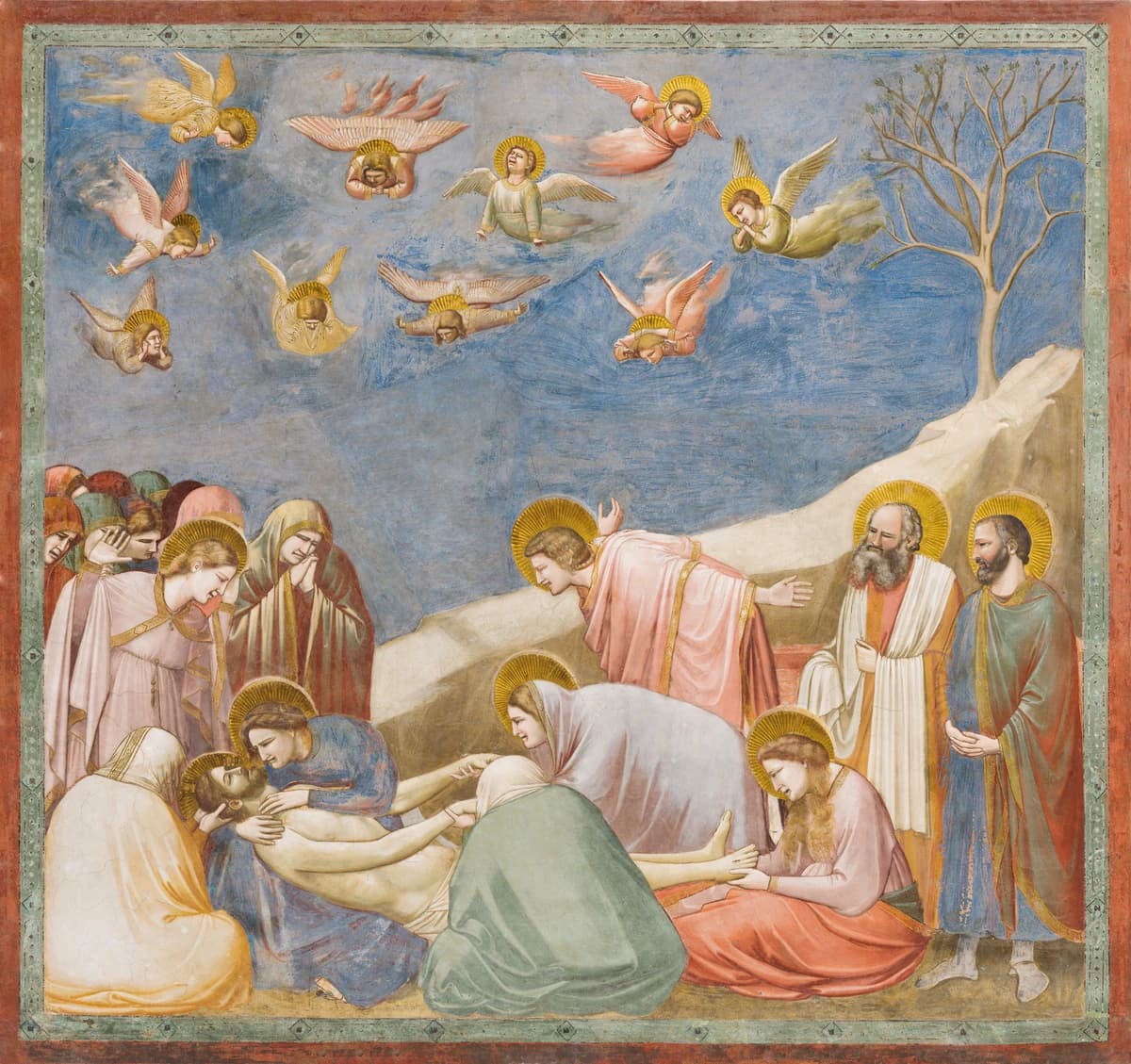
- The surface, at magnification. On the reference plate and on two others, a fine craquelure runs straight through skin, cloth, rock and sky alike, and no brushstroke is visible anywhere at page scale. The picture is in the plaster. That is what "matte" means here, and it is the rule the style lives or dies on.
- The palette, measured. On the reference plate, roughly four pixels in five carry colour; of those, about two thirds sit in one warm earth band and a fifth in the blue of the ground, and fewer than one pixel in five on the whole plate is more than half-saturated. The most saturated plate we kept still has fewer than three pixels in ten above half saturation; the quietest has fewer than one in fifty.
- Two shadow systems, one chosen. Giotto gives every form a shadow side and casts nothing on the ground. Masaccio, a century later, states one light for the whole wall — the chapel's real window — and puts a short cast shadow beside every foot. We chose Masaccio's rule, because it plants a figure on the ground and because it makes a candle or a night expressible: a light source is a painted object plus a direction, and the dark beyond it is flat.
- Two skies, one chosen. Giotto's ground is flat azurite; Masaccio's and Piero's is a pale clouded sky. We chose the flat ground, because a sky that is a colour field cannot be turned into weather by anything a story says.
- A rejected plate defines the boundary. A Signorelli crowd from 1500 was thrown out for sculptural, mannered anatomy modelled in the full round — the exact thing the fifteenth-century core does not do. The lineage ends with Piero.
- A rule we had to prove. The style has to survive a modern cast. Two Masaccio scenes full of fifteenth-century Florentines in hoods and purses, and the Marées pergola with its men in 1870s suits, show the grammar unchanged under contemporary dress. The twentieth-century muralists — Boychuk in Kyiv, Rivera and Orozco in Mexico, the New Deal post offices — are the same argument, but they are prose here, not plates: their works are destroyed, in copyright, or both.
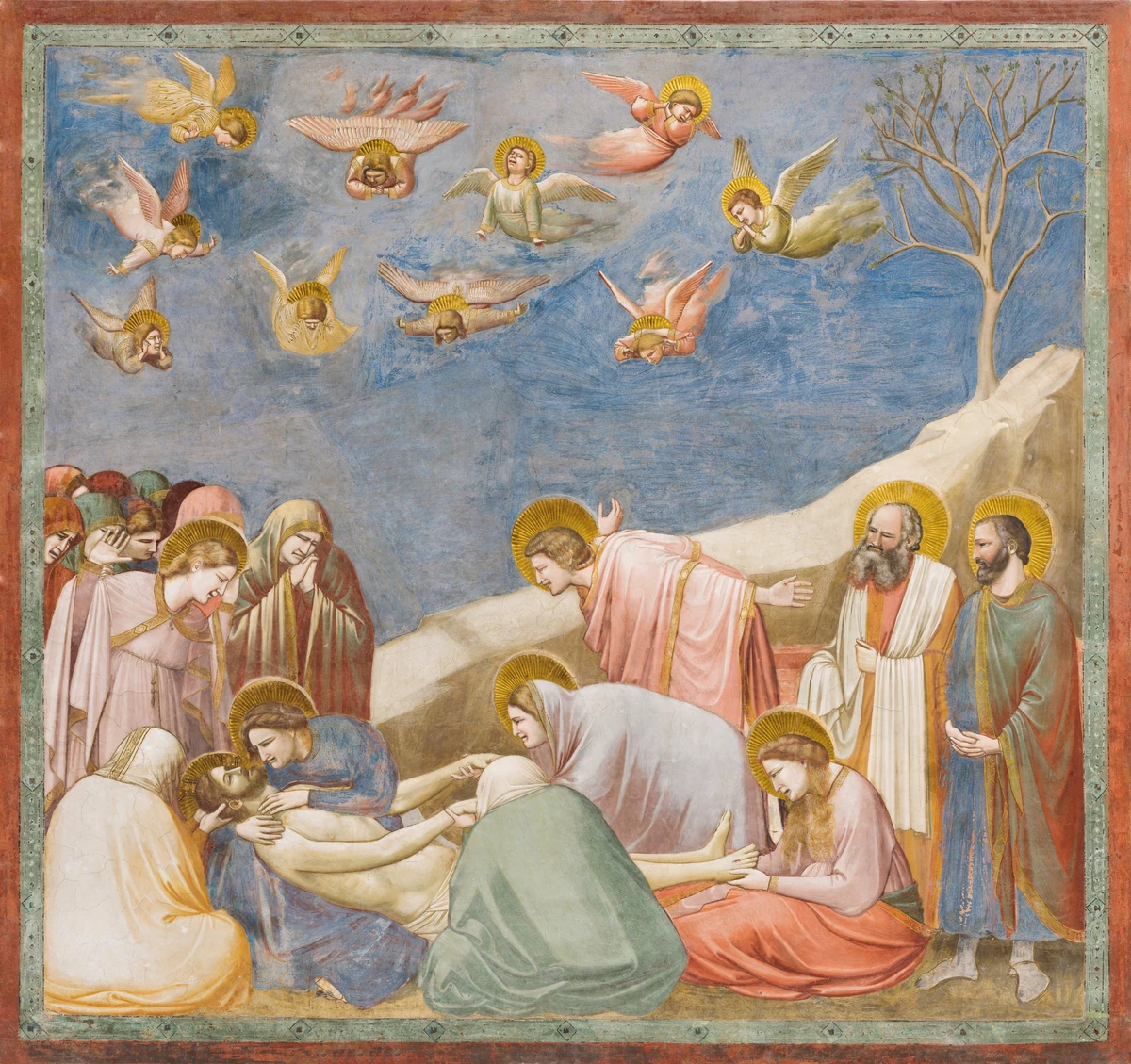 The reference plate: Giotto, Lamentation, Cappella degli Scrovegni, Padua, 1303–1305. Photograph released to the public domain by its author; the fresco is public domain by age. The hue populations quoted above were measured on this file. Its honest debits: the ten flying angels at different scales, and the halos — both excluded by the reference scope, since the style borrows the wall and not the iconography.
How a chess game reads in Monumental
Everything happens on a shallow stage, laterally, in the plane. Two players facing each other over a decisive move is a short scene of two figures in profile across a gap the eye must cross, hands carrying the argument, and a third of the wall left bare — the emptiness is the composition, not an unfinished area. A king hunt is two registers stacked on one wall and divided by a painted marble band that does the job of a gutter, with the standing heads keeping their line and the fallen laid along the ground line. That is how the tradition says someone has gone down.
Three consequences follow, and the style is written to hold them. A crowded position is legible without perspective, because a crowd is made by overlap and by stacking figures higher up the wall at the same size — never smaller by much, never paler, never softer. Weather is a painted sign rather than an atmosphere: rain is a rank of thin slanted lines over the blue ground behind the figures, wind is every cloak blown one way. And a lamp or a fire is a painted object plus the page's one light — no glow, no pool, the far side of the room a flat dark, as in Piero's Dream of Constantine, the first night scene in Italian painting.
It is the default style of the Spirit of '76, the Revolutionary War world, where the register does something the other worlds cannot borrow: an army painted onto a public wall is not a metaphor a reader has to be taught. It is also recommended for the Cossack world, whose own monumental school — Boychuk's — was built on exactly this synthesis of Giotto and the icon. But the style is not confined to either, and the reason is structural. Not one of its rules asks what anyone is wearing.
The bar a Monumental page has to clear
Fifteen checks, the last step of the four-step method behind every Chess2Story comic style.
- The matte test, the decisive one. No specular highlight anywhere on a figure: a bright white spot at a fold crest or on a cheek is gloss, and gloss is a digital painting wearing a fresco's name.
- The shadow-plane test. A value profile across a limb or a fold must step from lit plane to shadow plane, not ramp. A smooth ramp is an airbrush gradient.
- The ground test. Above the head line, the field must be one blue population with no gradient from top to bottom. A clouded or graded sky fails.
- Chroma ceiling. No more than three pixels in ten above half saturation — the ceiling the loudest kept plate sets.
- No black. No shadow region reaching near-black except a declared night ground; fresco has no black shadows.
- One light. The lit sides of several figures must agree. Per-figure keys and rim lights are out.
- Focus parity. Near and far figures carry the same detail. There is no depth of field on a wall.
- No outline. No closed contour of uniform dark width round a figure. That is an ink keyline, and this tradition has none.
- The head line. Standing heads within one head-height of a common horizontal, with declared exceptions for the kneeling, the seated and the fallen.
- The masked-border test. Cover the frame band; the picture must still read as a painted wall, not a digital painting and not a photograph of plaster.
- Zoom at 300%. Colour fields meeting at edges, craquelure crossing skin and cloth. Any brush texture, pore, airbrush ramp or photographic stucco fails.
- The face audit. Two planes, dark almond eyes with no highlight dot, no hatching. A catchlight fails.
- The iconography audit. No halo, no wings, no gold leaf unless the world put them there. "Giotto" is a technique here, not a subject.
- The lettering audit. Captions in a ruled inscription band, dialogue on a banderole with no tail, sound effects flat on the wall. A tailed balloon or a chrome effect fails.
- The blind test. An expert names the tradition first, unprompted.
Those are a checklist we read by eye when we calibrate the style and audit its pages, not software inspecting your particular page; the only passes that run on every page read the words, not the plaster. One more honesty: the picker tile and the style's own reference image are, at the time of writing, crops of the museum plate above rather than our own render, and will be replaced by a generated page built to this definition.
How Monumental letters a page
Text in Monumental is painted, not placed. The lettering rules come from Fra Angelico's corridor Annunciation at San Marco, where the caption is a painted inscription in Roman capitals running the full width of the wall between two thin ruled lines, in a strip under three per cent of the picture's height, and where those two ruling lines are the darkest rows on the whole plate. A caption is that strip — a reserved band of the same plaster along an edge — never a box laid over the art. Dialogue is a painted banderole, the scroll beside a speaker that is the balloon's ancestor, with no tail and no outline. Sound effects are painted capitals in one ochre or red earth, flat on the wall, with no outline, no drop shadow and no glow.
The result is a comic that reads as a wall with your game painted into it.