← All traditions

Buon fresco: how a story was painted into a wall

For two centuries the biggest pictures in Europe were painted into wet plaster, one day's patch at a time — and the rules that kept them legible across a room are not easel rules.

Chess2Story Research ·

Tradition
Buon fresco — monumental painting bound to the wall, from Giotto to Piero della Francesca
Era
1303–1466, revived from the 1870s
Key artists
Giotto di Bondone · c. 1267–1337Masaccio · 1401–1428Fra Angelico · c. 1395–1455Piero della Francesca · c. 1415–1492Benozzo Gozzoli · c. 1421–1497Hans von Marées · 1837–1887Mykhailo Boychuk · 1882–1937Diego Rivera · 1886–1957
Works to know

Giotto di Bondone, The Scrovegni (Arena) Chapel (1303–1305)Thirty-eight scenes in three tiers inside painted frame bands, under a flat azurite vault — the wall as a picture book.

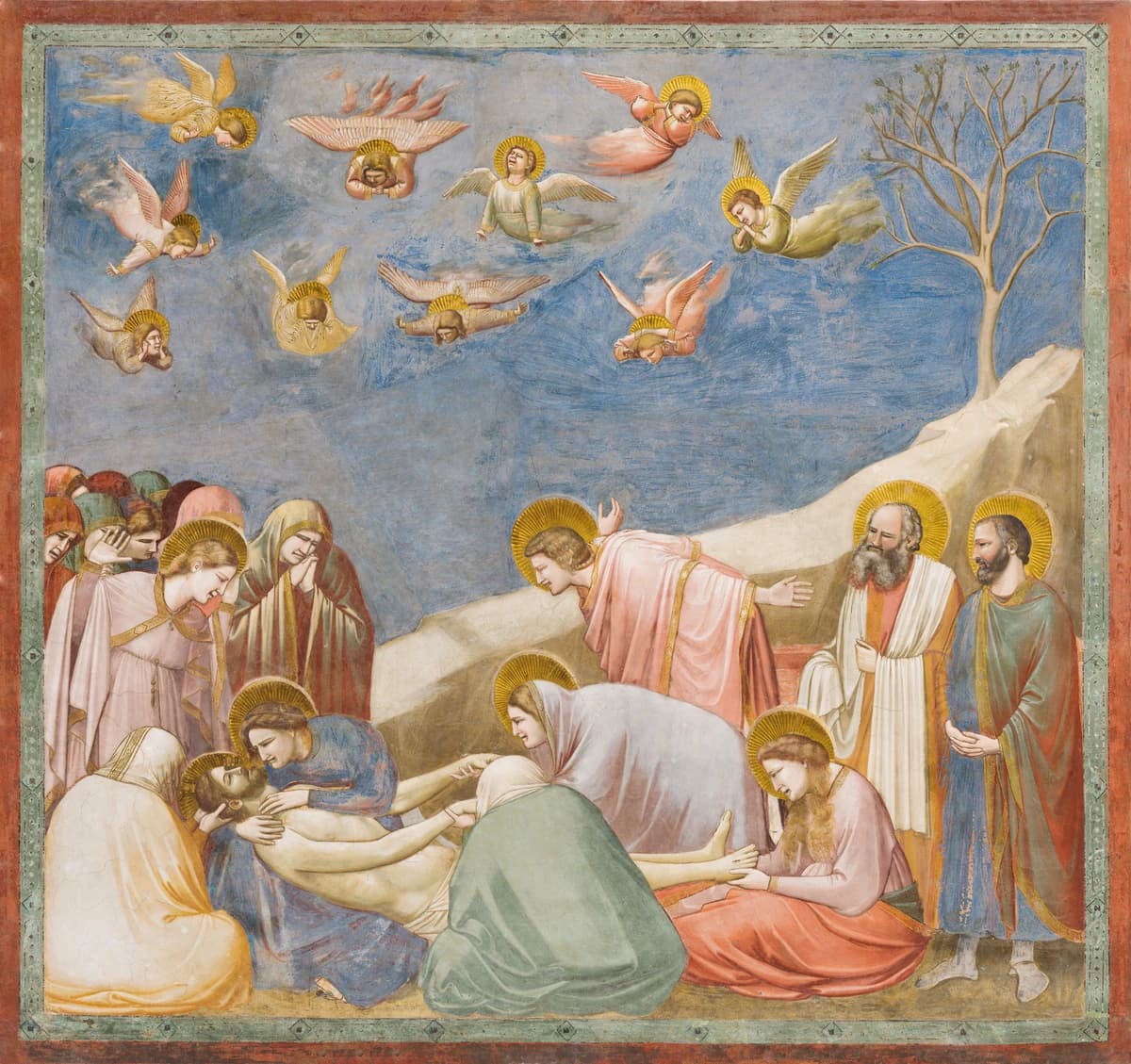
Giotto di Bondone, Lamentation (1303–1305)Ten mourners on one ground line, a diagonal rock that delivers the eye to two heads at the lower left, and grief carried entirely by hands and the tilt of heads.

Giotto di Bondone, The Arrest of Christ (Kiss of Judas) (1303–1305)A mob as a wall of overlapping heads, a forest of staves and torches against flat night-blue, and two profiles locked at the centre.

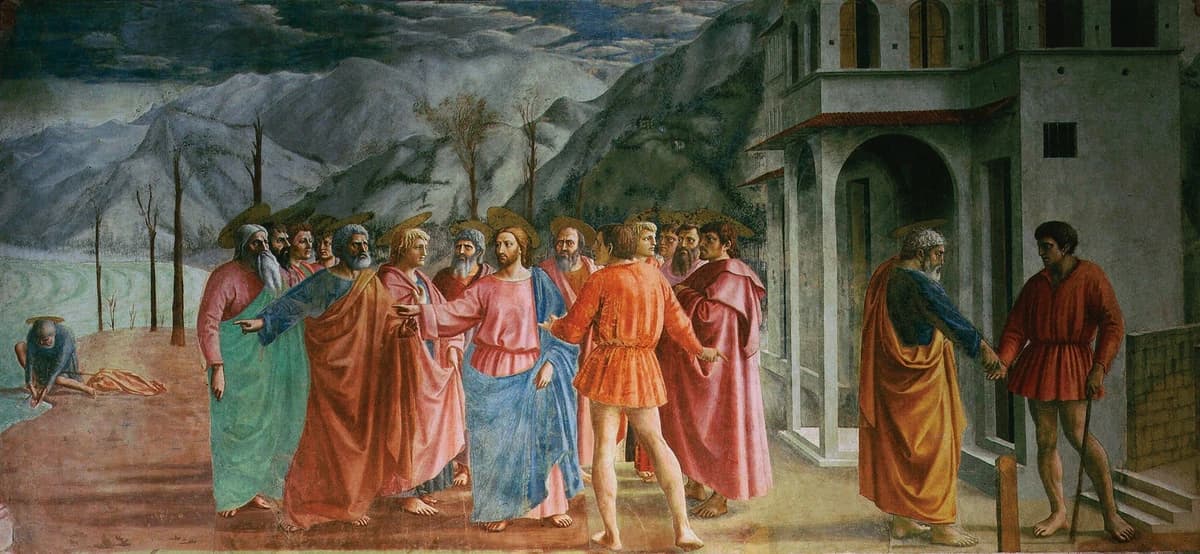
Masaccio, The Tribute Money (c. 1425–1427)Three episodes of one story in one frame, every standing head on one horizontal, and one light from the right casting a shadow beside every foot.

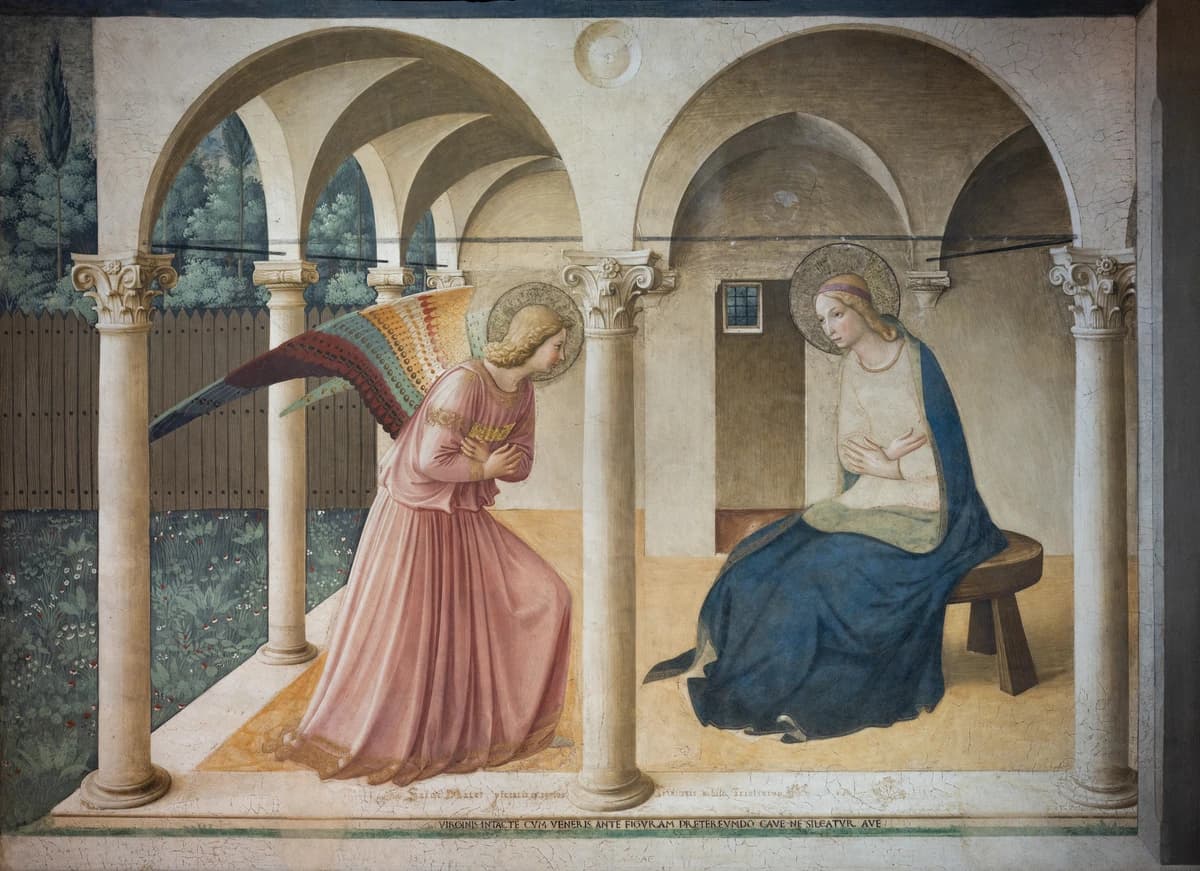
Fra Angelico, The Annunciation (north corridor, San Marco) (c. 1440–1445)A two-figure scene under a loggia with the caption painted into the wall beneath it in Roman capitals between two ruled lines.

Piero della Francesca, The Dream of Constantine (1452–1466)An angel carries the only light into a night camp; the lit surfaces are lit and the dark is flat — no glow anywhere.

Piero della Francesca, The Battle of Constantine and Maxentius at the Milvian Bridge (1452–1466)Cavalry in a side-on frieze under a forest of vertical lances and banners — an army as a band across a wall.

Ambrogio Lorenzetti, The Allegory and Effects of Good and Bad Government (1338–1339)The tradition's great secular wall, in Siena's town hall: a whole city and its countryside painted as a civic argument.

For most of the two centuries between 1300 and 1500, the biggest pictures anyone in Europe could see were painted into the walls of churches and town halls, and they were painted in a way that left the painter almost no room to change his mind. A fresco is not a picture hung on a wall; it is the wall, with the picture cured into its surface. That single fact — the chemistry of wet lime — generates most of the tradition's grammar, and the rest follows from the fact that a wall is read across a room.

The category has a name of its own in much of Europe. Monumental painting — the term is standard in Ukrainian and Russian art history — means painting bound to architecture: fresco, mosaic, sgraffito, stained glass, anything made for a specific building and meant to be legible from a distance. Its textbook features are scale relative to the human body, generalised form, large masses of colour and laconic composition. The Italian cycles from Giotto to Piero della Francesca are the case every textbook reaches for, and they are the subject of this page.

How the pictures were made

The wall was roughed with a coarse coat of lime plaster, the arriccio, and the whole composition was drawn on it in red earth — the sinopia, named for the Turkish port the pigment came from. Then, each morning, the painter or his assistants laid a patch of fine plaster, the intonaco, over exactly as much wall as could be painted before it set: a giornata, a day's work. Pigment ground in water was laid onto the wet lime, and as the plaster cured it bound the colour into a skin of calcium carbonate. The seams between one day's patch and the next are still visible under raking light on every fresco in the set; the Scrovegni Chapel took Giotto something over six hundred of them.

The chemistry dictates the palette. Only pigments that survive lime can go into the wet wall — the earths, yellow and red ochre and the siennas, terre verte, lime white, carbon black — and every one of them is lightened by the white of the plaster it sinks into. That is why a fresco is matte and chalky, why it has no black shadows, and why a fold is modelled by laying a darker field of the same earth beside a lighter one rather than by blending. Blue and gold were the exceptions. Azurite and ultramarine could not go into the lime, so they were laid a secco, onto the dry wall in a binder, after everything else had cured; so was the gold of halos and hems. A pigment sitting on the surface has none of a fresco pigment's grip, and seven centuries later Giotto's skies show the pale plaster through their losses while the figures beside them are intact.

The surface that results is the tradition's most important physical fact. There is no brushstroke visible at the scale a wall is read at. Colour arrives as fields with edges; a form is a lit field and a shadow field of the same hue laid side by side; a face is two planes of flesh tone, a lit cheek and a shadow side, with two dark almond eyes and a short line for a mouth. A fine craquelure runs through skin, cloth, rock and sky alike, because they are all the same plaster.

How a wall stands in for space

A wall is read from across a room, and depth built from haze and shrinking figures does not survive the distance. The fresco painters built depth another way. The picture is a shallow stage: one ground plane running the width of the scene, full-length figures standing on one ground line, their standing heads on one horizontal — the convention art historians call isocephaly — with the kneeling and the seated allowed below the line as marked exceptions, and the dead laid along it. Behind the figures stands one of three things: a flat blue ground; a piece of architecture painted like a stage flat — a gate, a tower, a loggia, a box-like room with its front wall removed so roof, side walls and back wall show at once; or a landscape of pale rock wedges and small round trees. A crowd is made by overlap and stacking: the second row overlapped to the shoulders, the rows behind set higher up the wall at the same size and the same clarity. A far figure is not paler and not softer. It is higher, and behind.

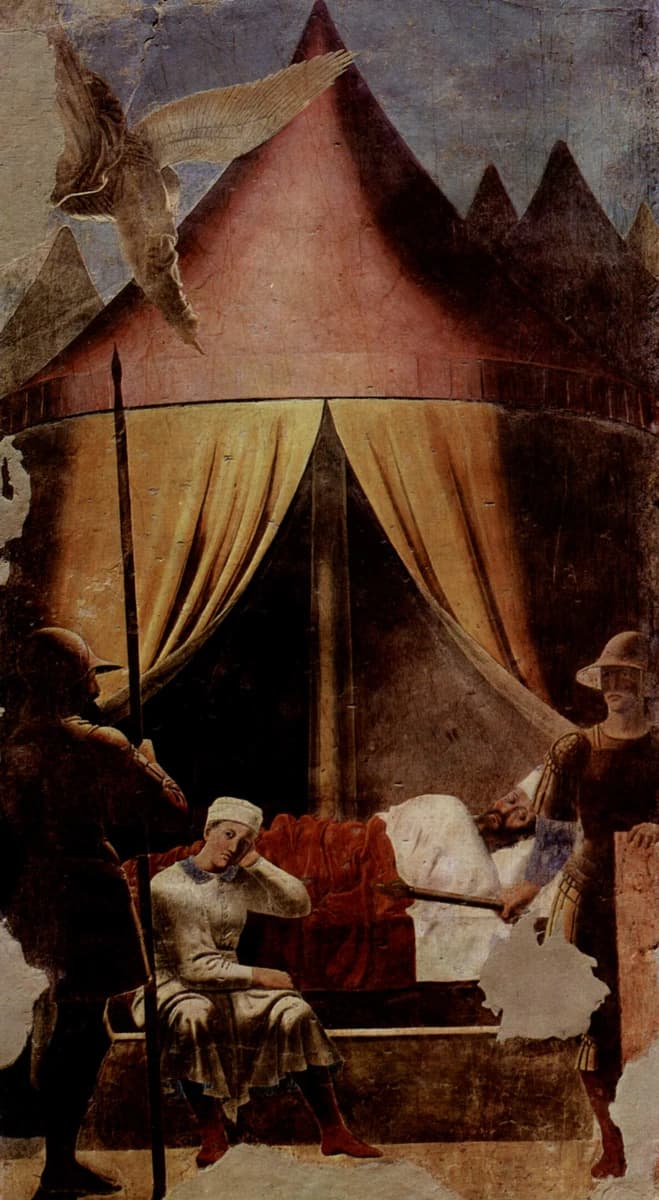
The tradition did evolve. Masaccio, in the Brancacci Chapel in the 1420s, gave a wall a single stated light — the chapel's own window — and let every figure cast a short shadow on the ground beside its feet; a century earlier Giotto's figures had a shadow side and cast nothing. Masaccio and then Piero della Francesca built real converging perspective for a street or a loggia. But they kept the figures on the shelf of the stage and never let distance soften anything, and when Piero painted the first night scene in Italian painting, the Dream of Constantine, he obeyed the older rule exactly: the angel is simply the brightest object, the surfaces it reaches are lit, and everything else is a flat dark with no glow.

Text obeyed the same rule as everything else. A caption was painted into the wall in a reserved strip of plaster ruled by two thin lines, in even Roman capitals in one earth pigment — the titulus. Fra Angelico's corridor Annunciation keeps its titulus intact under the loggia floor, in a strip under three per cent of the wall's height. Speech, where a painter needed it, ran along a painted scroll unfurling beside the speaker, the banderole — the direct ancestor of the speech balloon.

Who made it: the painters who changed something

Giotto set the regime in Padua in 1303–05: thirty-eight scenes in three tiers inside painted frame bands, under a vault of flat azurite. He gave the tradition its stage, its ground line and head line, its two-plane face and its way of carrying emotion in hands and the tilt of a head rather than in features. Masaccio, in his short life, gave it one light and a cast shadow, and painted fifteenth-century Florentines in hoods and purses into sacred stories without changing a rule. Fra Angelico frescoed the friars' cells at San Marco with the sparest scenes the tradition ever produced — four figures on a bare wall, the emptiness the composition — and painted the caption into the wall beneath his Annunciation. Piero della Francesca at Arezzo painted an army as a side-on frieze of horses under a forest of lances, and the night. Benozzo Gozzoli stacked the whole Medici court up a landscape in gilded dress, the tradition at its densest. Ambrogio Lorenzetti, in Siena's town hall, had already shown in 1338 that the grammar could carry a civic argument as well as a scripture: a whole city and its fields, painted as good government. The line ends with Piero; Signorelli's and Michelangelo's sculptural anatomy is a different art.

Where the grammar went

The tradition went to sleep and was deliberately woken. Hans von Marées painted true fresco in Naples in 1873 — zoologists in suits at a table under a pergola, on a plaster wall, by the older rules. Puvis de Chavannes covered the Panthéon and the Boston Public Library with matte, frieze-like walls. In Kyiv in the 1910s and 1920s Mykhailo Boychuk founded a school of monumental painting — Boychukism — on exactly this synthesis of Giotto, Byzantine mosaic and the Ukrainian icon; his students frescoed the Kharkiv theatre and the Odesa peasant sanatorium before the school was shot in 1937 and its walls jackhammered or painted over, so that the school survives mainly in photographs and in one rescued fragment of a woman's face. In Mexico, Diego Rivera came back from the Italian cycles in 1921 and, with Orozco and Siqueiros, made the fresco the public art of a revolution; in the United States the New Deal put more than a thousand murals into post offices. The mosaic walls of 1960s Kyiv are the same idea in glass.

Its compositional habits also long predate — and quietly supply — the ones comics later formalised: a story running along one shallow band, several bands stacked on one surface with a painted strip between them doing the work of a gutter, a caption painted inside the picture surface rather than laid on top of it, a scroll of speech beside a speaker, and depth signalled by overlap rather than by perspective.

From the chapel wall to a chess game

We built a comic style out of the fifteenth-century core — measured off these plates rather than off a description of them, down to the two ruling lines of Fra Angelico's painted caption, which turn out to be the darkest rows on the whole wall. If you want the artifact rather than the history, see our Monumental style; if you want to know how a style gets built from museum plates at all, we wrote up the method.
See the real works

Fra Angelico, The Annunciation, c. 1440–1445 — a kneeling angel with rainbow-barred wings and a seated woman in a dark blue mantle face each other under a vaulted loggia of slender columns, a fenced garden at the left, and a painted inscription in Roman capitals running along the bottom edge between two ruled lines
Fra Angelico, The Annunciation, north corridor, Convent of San Marco, Florence, c. 1440–1445. Photograph released to the public domain by its author; the fresco is public domain by age. The wall carries its own caption: a painted inscription in Roman capitals across the full width beneath the loggia floor, in a strip under three per cent of the picture's height, its two ruling lines the darkest rows on the whole plate. Light comes from the left and is stated once — every column has one lit and one shadow face.
Giotto di Bondone, Lamentation, 1303–1305 — a square fresco inside a red and green painted frame: ten mourners on one ground line around a dead figure at the lower left, a diagonal rock wedge running down from the upper right, a bare tree, and ten small angels in a flat blue ground above
Giotto di Bondone, Lamentation, Cappella degli Scrovegni, Padua, 1303–1305. Photograph released to the public domain by its author. The painted frame — a red outer band, a green inner band with a running inlay pattern — is the wall's own gutter. A diagonal rock delivers the eye to the two heads at the lower left; the standing heads hold one horizontal; the crouching mourners in front are solid blocks of green and yellow cloth with nothing drawn inside them. Roughly two thirds of the plate's colour sits in one warm earth band and a fifth in the blue of the ground.
Masaccio, The Tribute Money, c. 1425–1427 — a wide band with a ring of robed figures at the centre on a bare ground before grey hills, a small figure crouching at a lake on the far left, and two figures at a doorway of a house in perspective on the right
Masaccio, The Tribute Money, Brancacci Chapel, Santa Maria del Carmine, Florence, c. 1425–1427. Public domain by age. One story told three times in one frame — the demand at the centre, the coin found in the fish at the left, the payment at the right — with every standing head on one horizontal across the whole width. Light comes from the right, the side of the chapel's real window, and every figure casts a short shadow to the left: the first fresco with a stated light source.
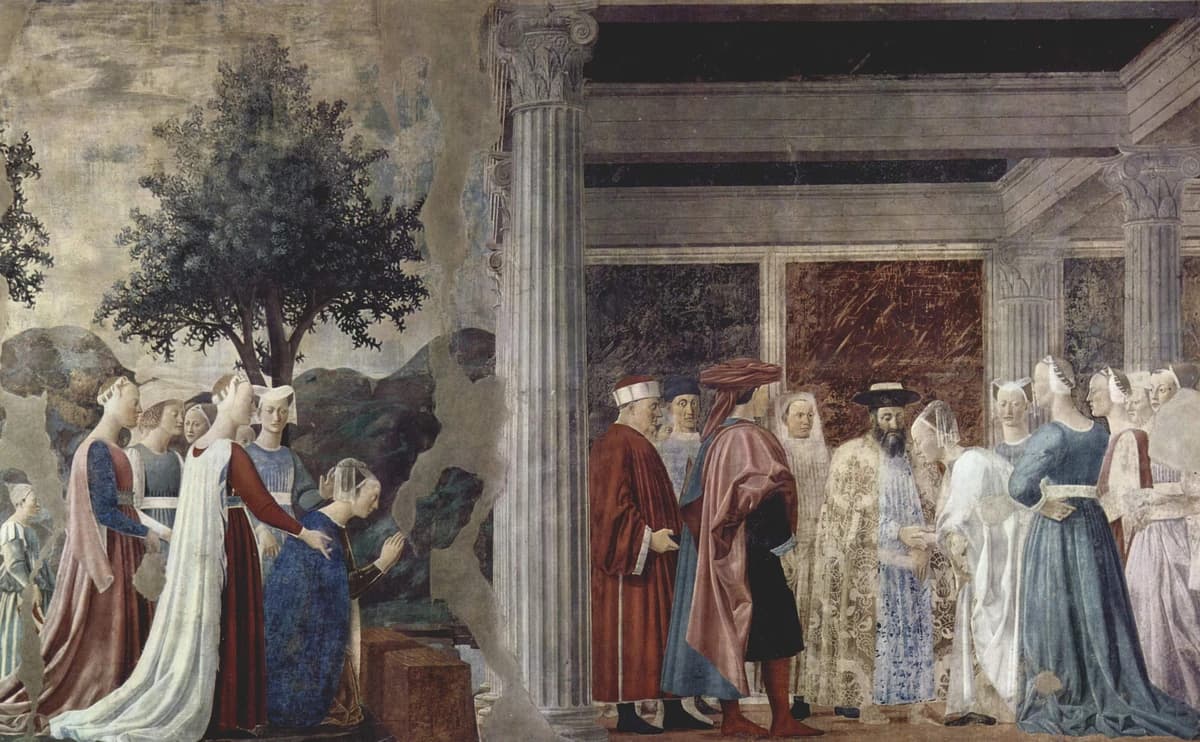
Piero della Francesca, Procession and Meeting of the Queen of Sheba and Solomon, 1452–1466 — on the left a queen kneels before a beam in a landscape with a round tree while her ladies stand behind her; on the right, inside a loggia of fluted columns, she clasps hands with a bearded king among courtiers in pleated robes
Piero della Francesca, Procession of the Queen of Sheba and Meeting of Solomon and the Queen of Sheba, San Francesco, Arezzo, 1452–1466. Public domain by age. Two episodes in one band, divided by a single column like a gutter; every standing head, left and right, on one horizontal; the loggia drawn in real perspective but kept as a shelf the figures stand on. Piero's faces are the tradition's stillest — an oval, two almond eyes, a mouth.
Piero della Francesca, The Dream of Constantine, 1452–1466 — a conical tent at night lit from above by a diving angel, the emperor asleep inside, a servant seated on the bed step with his head on his hand, two guards standing in front, everything beyond the light a flat dark
Piero della Francesca, The Dream of Constantine, San Francesco, Arezzo, 1452–1466. Public domain by age. The first night scene in Italian painting, and the tradition's rule for any lamp, candle or fire: the light source is a painted object — here the angel — plus a direction; the surfaces it reaches are lit, the rest is flat dark, and nothing glows.
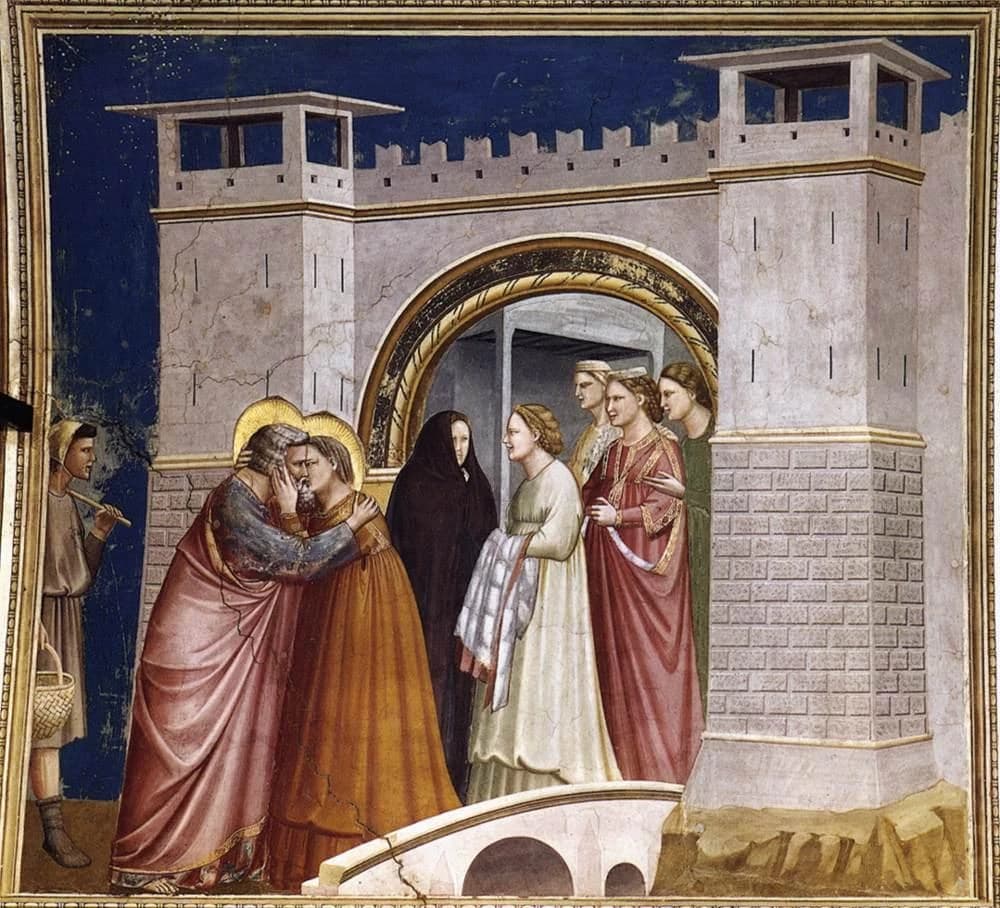
Giotto di Bondone, Meeting at the Golden Gate, 1303–1305 — a bearded man and a woman embrace on a low stone bridge before a crenellated city gate with two towers, four women watching from the gateway and a shepherd with a basket at the far left, against a flat dark blue ground
Giotto di Bondone, Meeting at the Golden Gate, Cappella degli Scrovegni, Padua, 1303–1305. Public domain by age (Web Gallery of Art reproduction). A bridge as a low stone arc that doubles as the ground line, a city gate as a stage flat with parallel-line recession, a flat azurite ground with no cloud and no horizon, and the two principals meeting in profile at the exact centre with their heads level with the onlookers'.
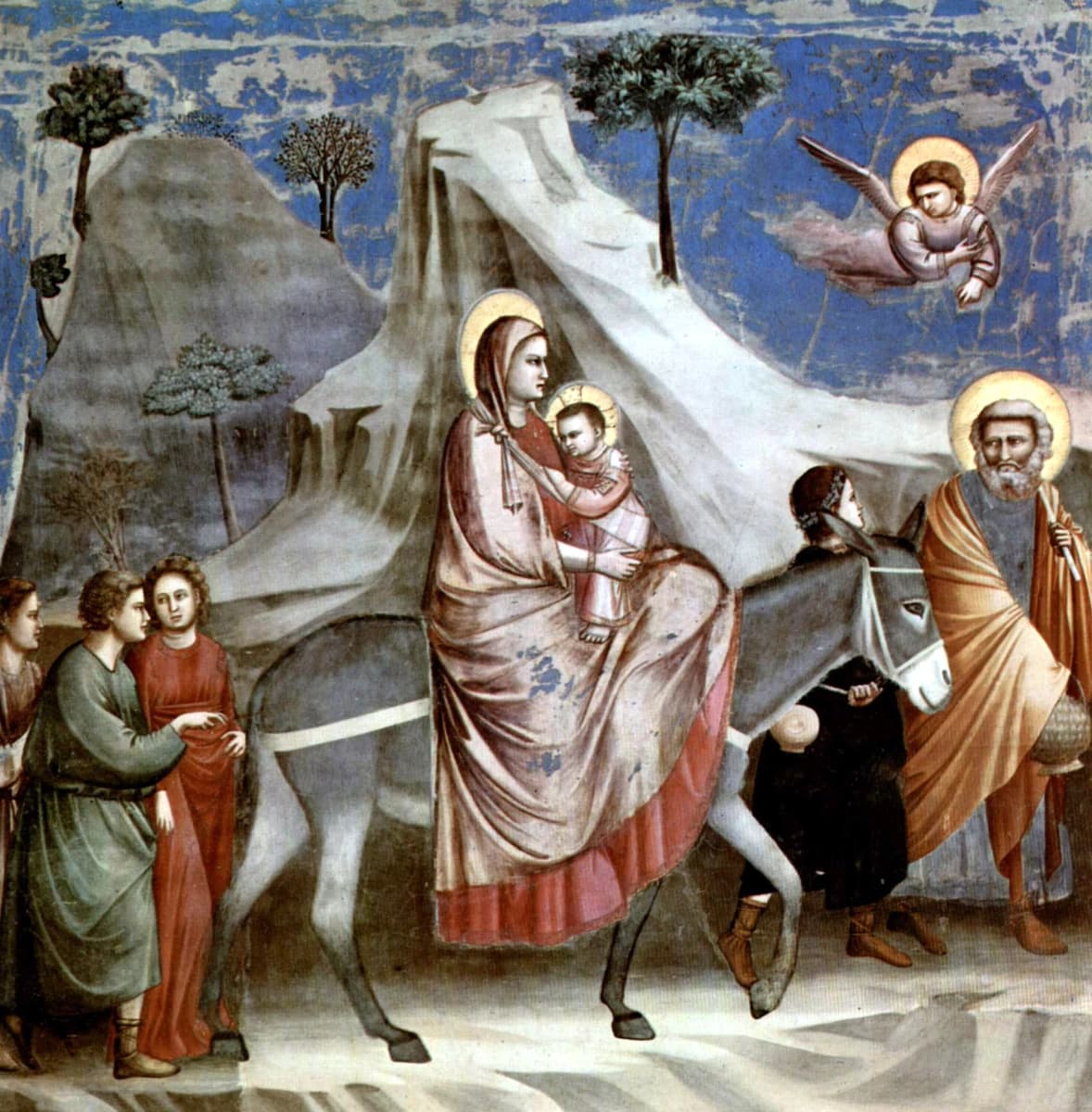
Giotto di Bondone, Flight into Egypt, 1303–1305 — a woman in a pink robe holding a child rides a grey donkey led by a youth, a bearded man in an ochre cloak walks at the right, three figures follow at the left, and an angel flies above, all before a pale grey rock rising to a peak and a flaking blue ground
Giotto di Bondone, Flight into Egypt, Cappella degli Scrovegni, Padua, 1303–1305. Public domain by age (Yorck Project scan). The landscape is a stack of pale rock wedges with hard edges, the central peak rising directly behind the central figure so figure and ground share one silhouette; the sky is flat azurite with large losses showing the plaster beneath, because the blue was laid onto the dry wall and has flaked.

Frequently asked questions

What is buon fresco?

Buon fresco is painting into wet lime plaster. A patch of fine plaster is laid on the wall each morning and the painter lays water-ground pigment onto it while it is still damp; as the lime cures it locks the pigment into a skin of calcium carbonate, so the colour is in the wall rather than on it. That is why a true fresco is matte and chalky, why every colour is lightened toward the plaster's white, and why the palette is limited to pigments that survive lime — mostly earths, with blue and gold added afterwards onto the dry wall.

What is monumental painting?

Monumental painting is the art-historical name — especially in Ukrainian and Russian usage — for painting bound to architecture: fresco, mosaic, sgraffito and stained glass made for a particular wall and meant to be read from a distance. Its defining features are scale relative to the human body, simplified and generalised form, large masses of colour, and laconic composition, all of which follow from the need to be legible across a room. The Italian fresco cycles from Giotto to Piero della Francesca are its textbook case, and the twentieth-century mural is its revival.

Why do fresco skies flake off?

Fresco skies flake because the blue was not painted into the wet plaster. Azurite and ultramarine react badly with wet lime, so painters applied them a secco — onto the dry wall in a binder — after the rest of the scene had cured. A pigment lying on the surface has none of the chemical grip a fresco pigment has, and over seven centuries it lifts and falls away, which is why so many of Giotto's skies show the pale plaster underneath while the figures beside them are intact. Gold halos and gilded hems were applied the same way and have suffered the same fate.

Why does a fresco have no perspective distance?

A fresco has no perspective distance because it was built to be read across a room, and depth built from haze and shrinking figures does not survive distance. Instead the fresco painters used a shallow stage: one ground plane, full-length figures standing on one line with their heads on one horizontal, and behind them a flat blue ground or a piece of architecture painted like a stage flat. A crowd is made by overlapping the second row and stacking further rows higher up the wall at the same size and the same clarity. Masaccio and Piero added real convergence for a street or a loggia, but never let it swallow the figures and never softened anything with distance.

How were captions written on a fresco?

Fresco captions were painted into the wall like everything else. Under a scene the painter reserved a plain strip of plaster, ruled it with two thin lines, and lettered a Latin inscription across it in even Roman capitals in one earth pigment — the titulus. Fra Angelico's corridor Annunciation at San Marco keeps its titulus intact under the loggia floor, in a strip under three per cent of the wall's height. For speech, medieval and early Renaissance painters used the banderole, a painted scroll unfurling beside the speaker with the words along it — the direct ancestor of the comic-strip speech balloon.

This tradition became a comic style

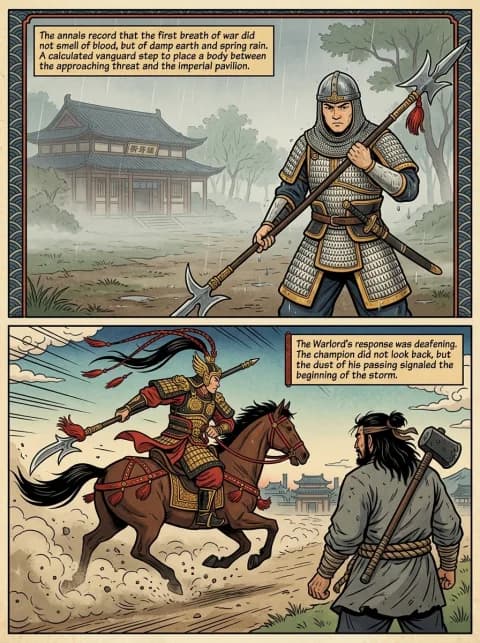
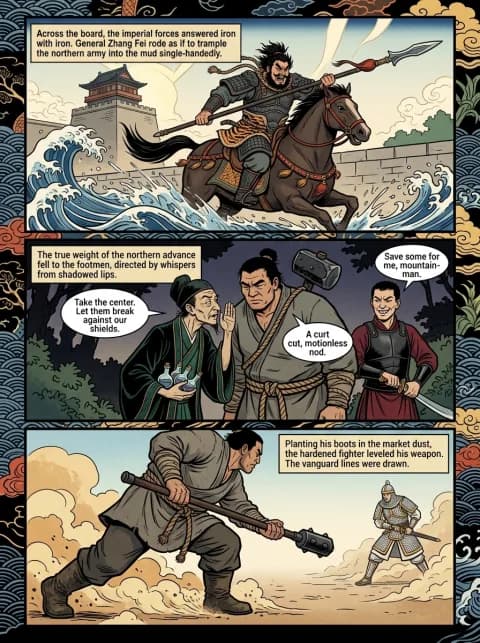
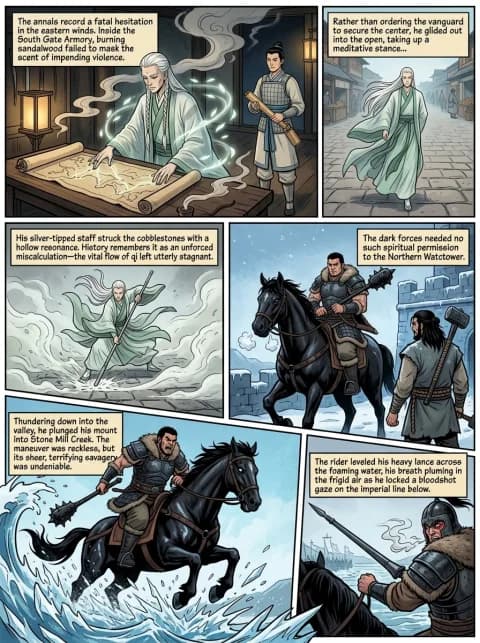
We studied plates like these and distilled what makes them work into rules a machine must follow — and a chess game can be rendered in.

From Bill Gates vs Magnus Carlsen (2014) — a full chess game rendered end to end.

Comic page 1 rendered from Bill Gates vs Magnus Carlsen, 2014Comic page 2 rendered from Bill Gates vs Magnus Carlsen, 2014Comic page 3 rendered from Bill Gates vs Magnus Carlsen, 2014

See this game’s comics →