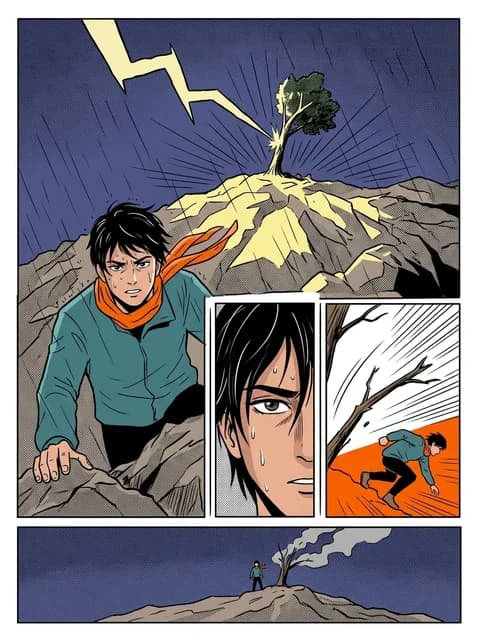
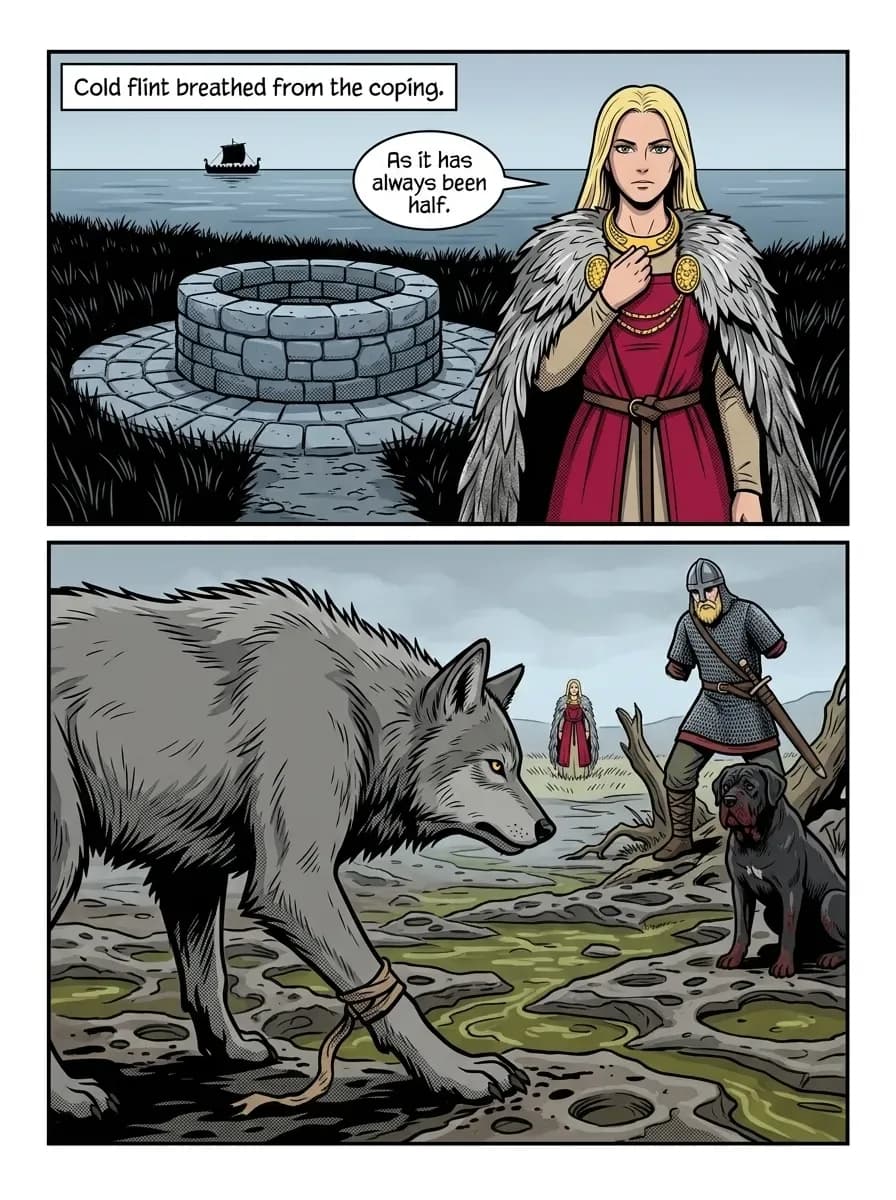
Shōnen Colour is not manga, and its name says so. It is a full-colour action comic descended from the colour opening pages of weekly shōnen magazines. It keeps the grammar of our Manga style — moves broken into beats, consequences drawn on faces — and adds what a black-and-white page cannot: a cast told apart by colour.
What Shōnen Colour was built around
Shōnen Colour has no research dossier of its own. Its staging rules, face recipe and typed effect lines come from the Manga style's evidence: fifty interior pages of copyrighted manga inspected one at a time and never stored, with the board-game pages from Blitz, March Comes in Like a Lion and Death Note supplying the staging. The history behind that grammar, from Hokusai's sketchbooks to the weekly magazines, is told in the manga tradition in the Lab. Nothing here adds a museum plate or a measurement. The reference plate is a generated page, with one figure and no lettering, that a person accepted by eye.
Four rules hold the colour to a printed page:
- Printed texture on every page. A coarse halftone dot screen, its dots visible, textures the shadows, skies and the space behind a head, and solid ink black fills the deepest darks.
- Clean white paper. Gutters are white. The page is never cream, aged or parchment.
- No glows. Every light, hologram, spell or burst of energy is a flat shape of bright colour bounded by an ink line, never a soft glow or bloom.
- Uneven panels. One panel takes at least forty percent of the page height, one is a thin strip under a fifth, and no two panels on a page are the same size.
Colour itself is flat. Each surface takes one clean local colour plus one hard-edged shadow shape in a deeper shade of the same hue, laid inside the ink line, which sits on top of everything.
How a chess game reads in Shōnen Colour
The staging is the Manga style's. A move is three beats: the piece approaches with speed lines trailing it, makes contact in a tight panel where focus lines converge on a bright empty centre, and settles in a held close-up. Consequences land on faces, through eye-band crops, sweat beads and shadow lines across the brow. The two sides' leaders face off as two adjacent eye panels rather than one two-shot. Where Manga spends a solid-black flash on the shock, Shōnen Colour floods one impact panel's ground with a single saturated colour, at most once per page. Quiet wide panels of small figures on open white ground give the loud ones their size.
Colour changes what a page can carry. Figures keep the saturated colours their character sheets name, while grounds take lighter tints so the cast reads first. That makes a crowded middlegame legible at a glance: house colours, armour and banners sort the two sides before any caption does. Worlds full of light suit it too: the holograms of a space setting become flat bright shapes with an ink edge. Sound effects are hand-drawn Latin letters filled with one flat colour inside a black keyline; the page is told never to draw kana.
Pick Shōnen Colour when the game is fast and the board is busy; pick Manga when one silence and one move decide it.
The bar a Shōnen Colour page has to clear
A Shōnen Colour page is held to these checks:
- White paper and white gutters, never cream or aged paper.
- Dot screen and solid black visible on every page.
- Flat colour: one local colour and one hard shadow shape per surface, with no blended, painterly or three-dimensional modelling.
- No glow, bloom, rim light or airbrush, with every light drawn as a flat shape with an ink edge.
- Uneven panels, never an even grid, and at most one colour-flooded impact panel per page.
These are a checklist we read by eye when we calibrate and audit the style, not a filter running inside the renderer. The check that does run on every page is the lettering pass. It transcribes the page and flags any text the script did not ask for, such as an invented caption or a run of made-up Japanese characters, and empty balloons. A flagged page is re-rendered, though if no attempt comes back clean, the least-flawed one ships. These checks are the last step of the four-step method behind every Chess2Story comic style.
The result is your game as a colour action comic: crisp ink, hard colour, and one loud panel on the move that mattered.